Join the AI Revolution

Join the AI Revolution

AI (Artificial Intelligence) is the defining technology of our times. It’s augmenting human ingenuity and helping us solve some of society’s most pressing challenges.

Satya Nadella, CEO of Microsoft

70%

said they were more productive

29%

faster overall in a series of tasks (searching, writing and summarizing)

4X

faster catching up on a missed meeting

77%

said they didn't want to give it up

*CoPilot deployments

The flexibility of AI systems contributes to the confusion created within businesses as to the best AI strategy to harness its capabilities with many simply “turning it on” or worse, having no controls over how staff are using it (and they will be using it!)

The best AI strategy is delivered in phases, with each stage delivering value and providing feedback into the implementation of the next phase of delivery. A successful AI strategy is never-ending, but it is a cycle of continuous improvement.

The approach Wavex takes helps clients avoid many of the pitfalls in deploying these new technologies.

Our approach includes the following steps

Organisation Readiness / Workshop

  • Evaluate your current Microsoft 365 (M365) environment to ensure compatibility with M365 CoPilot. This includes checking that your tenant is on a supported version and that necessary subscriptions (e.g., M365 CoPilot licenses) are available.
  • Review data governance policies, as CoPilot relies on Microsoft Graph to access organisational data like emails, files, and chats. Ensure data in SharePoint is well-organised, irrelevant data is archived, and permissions are appropriately set to avoid oversharing risks.

Configuration / Licenses

  • Purchase the required M365 CoPilot licenses for users who will access CoPilot Chat. These are typically add-ons to existing M365 plans (e.g., Business Premium, E3, or E5).
  • Define test groups (those individuals who can run through a set of scenarios and provide feedback)
  • Configuration CoPilot for use by test group.

Set Up Security and Compliance Controls

  • Recommended, but not essential, leverage Microsoft Purview to apply sensitivity labels and data loss prevention (DLP) policies to protect sensitive information accessed by CoPilot.
  • Configure enterprise data protection (EDP) settings, which are enabled by default for Entra account users, to ensure data privacy and compliance with organisational standards.
  • Decide whether to allow web grounding (access to Bing search) and manage it via admin controls if needed.

Test and Pilot Deployment

  • Conduct a pilot with a small group of users to test functionality, gather feedback, and identify potential issues (e.g., data access errors, performance lags, or erroneous answers).
  • Verify that CoPilot Chat integrates correctly with Teams, Outlook, and the Microsoft 365 app and that it meets user expectations for tasks like summarising emails, answering questions, or drafting content.

Train Users and Drive Adoption

  • Provide training sessions or resources (e.g., Microsoft’s CoPilot Success Kit) to educate users on how to use CoPilot effectively, including crafting good prompts.
  • Highlight key use cases like catching up on chats, drafting messages, or accessing work data to encourage adoption. The focus here is to slowly change behaviours so staff actively leverage the value of these tools within their workflows.

Monitor and Optimise

  • Use analytics to track usage and performance.
  • Collect user feedback to refine the deployment and address any concerns.
  • Adjust configurations as needed, such as expanding licenses, expanding learning sources, or tweaking permissions based on pilot results.

Organisations possess a vast, untapped resource in the form of unstructured data. Using modern AI systems, Wavex assist clients in unlocking this value to improve efficiency, reduce costs and empower their teams.

Gavin Russell, CEO: Wavex Technology
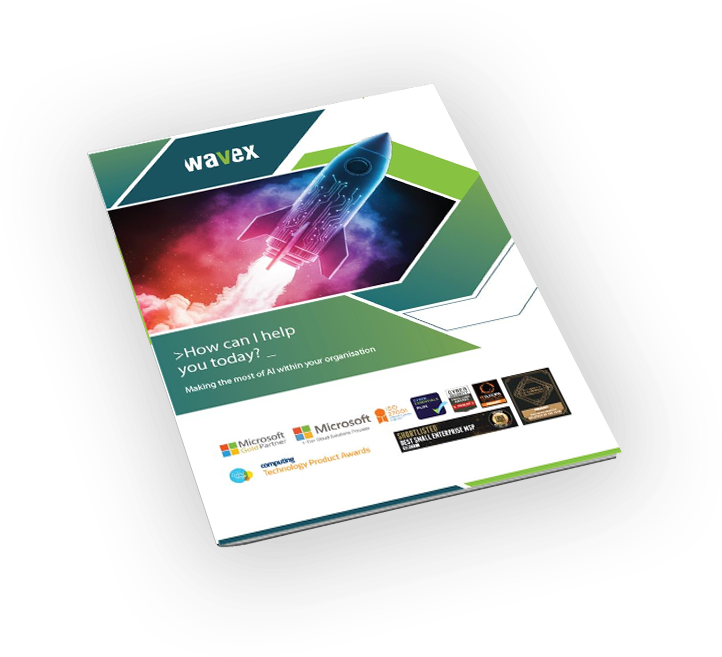
Trending ebook

“>How can I help you today?” – making the most of AI within your organisation

Our free ebook will help you understand AI, which AIs are the most popular, the risks and who within your organisation stands to benefit the most. Download now

The steps we take to help you get the most from AI

  • Organisation readiness / workshop

  • Configuration / Licenses

  • Set Up Security and Compliance Controls

  • Test and Pilot Deployment

  • Train Users and Drive Adoption

  • Monitor and Optimise

FAQs about Join the AI Revolution

Businesses today have access to a wide variety of AI technologies, each designed to solve specific challenges and drive efficiency, insight, and innovation. The key is selecting the right combination of AI tools that aligns with operational goals, available data, and the workflows that need enhancement. Not every AI solution fits every business, success depends on understanding the use case, potential impact, and how the AI integrates with existing systems.

Common types of AI suitable for businesses include:

  • Generative AI: Produces content, summarises documents, drafts emails, and generates reports, helping teams save time on routine writing or creative tasks.
  • Predictive analytics: Uses historical data to forecast trends, optimise inventory, predict customer behaviour, and guide strategic decision-making.
  • Natural Language Processing (NLP): Enables machines to understand and respond to human language, powering chatbots, summarisation tools, sentiment analysis, and advanced search.
  • Machine Learning: Detects patterns in large datasets to optimise processes, improve product recommendations, identify risks, or uncover hidden opportunities.
  • Robotic Process Automation (RPA): Automates repetitive, rule-based tasks across multiple systems, such as data entry, transaction processing, and workflow management.
  • Computer Vision: Analyses images and videos for applications such as quality control, security monitoring, or visual inspection in manufacturing or retail.

By working with a trusted partner like Wavex, organisations can identify the AI technologies that provide the most value, integrate them seamlessly into workflows, and scale solutions as business needs grow. With structured selection, pilot deployment, and ongoing optimisation, AI becomes a strategic enabler, delivering measurable results while maintaining security, compliance, and operational stability.

AI, today, has become a practical tool that can transform how businesses operate. By combining data analysis, automation, and machine learning, AI allows organisations to work smarter, make faster decisions, and respond to challenges more effectively. Its impact is felt across every department, from finance and HR to customer service and operations, helping teams focus on strategic priorities rather than repetitive tasks.

Beyond internal efficiency, AI helps companies enhance their competitiveness in the market. It enables better customer experiences, uncovers insights that drive innovation, and supports the adoption of data-driven strategies that can lead to measurable growth. The key to success is identifying where AI can add the most value and implementing it in a structured, well-governed way.

Practical ways AI can help businesses include:

  • Automating routine work: AI can process invoices, organise files, draft summaries, and handle repetitive administrative tasks, freeing staff to focus on higher-value projects.
  • Data-driven decision-making: By analysing large volumes of data, AI identifies patterns, predicts trends, and provides actionable insights to improve strategic planning.
  • Enhanced team collaboration: Tools like AI-driven summarisation or virtual assistants help teams access critical information faster and stay aligned across projects.
  • Smarter customer interactions: AI-powered chatbots, recommendation engines, and sentiment analysis deliver faster, personalised, and more accurate customer support.
  • Innovation and opportunity identification: AI can detect inefficiencies, predict market changes, and reveal new opportunities for products, services, or process improvements.
  • Scalability and flexibility: AI solutions can grow alongside the organisation, handling increased data volumes, expanding users, and adapting to new business needs without major infrastructure changes.

Wavex supports organisations in leveraging AI strategically, helping identify the right applications, integrate solutions with existing workflows, and monitor adoption. This ensures AI delivers measurable business outcomes while maintaining security, compliance, and operational stability.

  • Understand business objectives and challenges: Before exploring AI tools, it’s crucial to define what your organisation is trying to achieve. AI works best when it aligns with strategic priorities, whether that’s improving customer service, streamlining operations, accelerating decision-making, or uncovering new business opportunities. Taking the time to clearly map goals ensures any AI solution addresses a real business need rather than being a technology experiment.
  • Assess existing workflows and processes: Evaluate current operations to identify repetitive, manual, or error-prone tasks that can benefit from automation or AI-driven insights. Understanding the full workflow, including dependencies between teams and systems, helps highlight where AI can add the most value, and ensures that implementation won’t disrupt critical processes.
  • Evaluate data quality and readiness: AI relies heavily on data, so it’s essential to assess whether your organisation’s data is accurate, structured, and accessible. Poor-quality data can lead to inaccurate results or unreliable recommendations, so preparing and cleaning data is a foundational step before deploying any AI solution.
  • Define specific AI objectives and use cases: Narrowing down what you want AI to achieve is key to a successful deployment. Examples include summarising emails to save time, automating reporting, predicting sales trends, or assisting customer support teams. Clear objectives allow you to measure impact, prioritise resources, and ensure that AI adoption translates directly into tangible benefits.
  • Address risks and governance considerations: AI adoption comes with challenges, including data privacy, security, regulatory compliance, and change management. Planning for these early ensures the organisation can maintain control, prevent misuse, and build trust among employees while safeguarding sensitive information.
  • Develop a phased adoption roadmap: Implement AI incrementally, starting with high-priority use cases. By deploying AI in stages, your organisation can learn from each phase, adapt processes, and expand the solution progressively. This approach reduces disruption, manages investment risk, and allows teams to gain confidence in the technology.
  • Continuous monitoring and optimisation: AI adoption is an ongoing process. Regularly measuring performance, tracking ROI, and refining algorithms or workflows ensures that the solutions remain effective, relevant, and aligned with evolving business objectives. Over time, this allows AI to deliver increasing value and supports long-term digital transformation.

Wavex works closely with organisations to guide every stage of this process, from readiness assessments and pilot deployments to phased adoption and ongoing optimisation. This structured approach ensures AI is integrated securely, adopted effectively, and aligned with business priorities, ultimately delivering measurable results and sustainable value.